


Every album on NativeDSD rests on one idea: music should reach you exactly as it was captured, with nothing lost along the way. That idea didn’t start with a download store. It started more than 25 years ago, with a cellist, a new recording format and a team from Philips.
A new format
At the turn of the millennium, Philips and Sony were developing the Super Audio CD, built on a new way of capturing sound: Direct Stream Digital, or DSD. PCM, the format behind the CD, measures the signal at intervals and stores each measurement as a number. DSD works differently. It carries the music as a continuous, very fast stream of ones and zeros, where the density of the bits follows the waveform itself. Like the groove of a vinyl record or the signal of an FM radio, the music lives in the medium rather than being transcribed into it. That’s why we say DSD is the new analog. (Read the full explanation in our white paper: DSD is the New Analog.)
Philips, based in Eindhoven, went looking for a label to help bring the format into the world. It found Channel Classics, the Amsterdam label Jared Sacks had founded in 1990, and asked him to help implement and promote the new technology.
The first DSD recordings
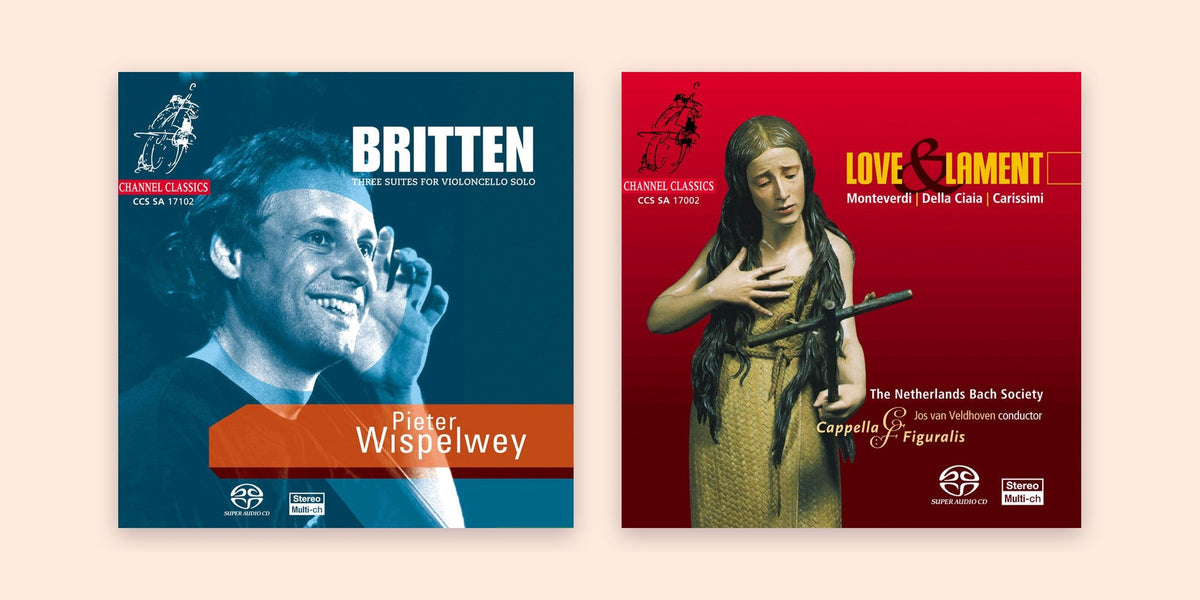
One of the first results was Pieter Wispelwey’s recording of Britten’s Three Suites for Violoncello Solo, released in 2002. It was recorded in DSD on dCS converters, and the booklet thanks five members of the Philips team in Eindhoven for their support in making it. It is still available on NativeDSD today.
Next came Love & Lament with the Netherlands Bach Society. Jared later recalled it as his second DSD recording:
To hear recorded voices like the last track from Carissimi was a startling discovery. I could actually enjoy the recorded voice! Hearing the depth of sound, intimacy, yet not ‘in-the-face’ sound.
Jared Sacks
None of this was routine yet. Jared mastered the album at the Philips development lab in Holland, and it took months of software work to get the master out of the computer.
Editing in DSD wasn’t practical, so engineers edited and mixed in DXD, a very high-resolution PCM format. That is how most DSD albums are still made today.
From disc to download
An SACD is still a disc, and a disc is a compromise: the master has to be packaged into a consumer format. When Philips and Sony stopped developing DSD equipment, Channel Classics tried something new. It began selling digital copies of the master recordings themselves, the files as they came out of the session.
The timing was right. Internet speeds had increased, and the first DACs that could play DSD natively were reaching listeners, with Mytek among the pioneers. Jared and his son Jonas saw what this could become for every label recording in high resolution, not just one. Together they built a single platform for it, and NativeDSD launched at CES in Las Vegas in January 2014.
Our promise: the first-generation master
That origin still shapes how we work. We go the extra mile to get the purest, first-generation edit master of every recording directly from the engineers who made it. Many stores simply pass on whatever their distributor sends them. We go back to the source.
Today Jonas leads NativeDSD, and the catalogue has grown to thousands of albums from more than 100 labels, with new releases every week. Each one follows the principle that began in Eindhoven: Music in its Purest Form.
Want to know more about the engineer behind those first recordings? Read our portrait of Jared Sacks → Jared Sacks: The Art of Natural Sound


