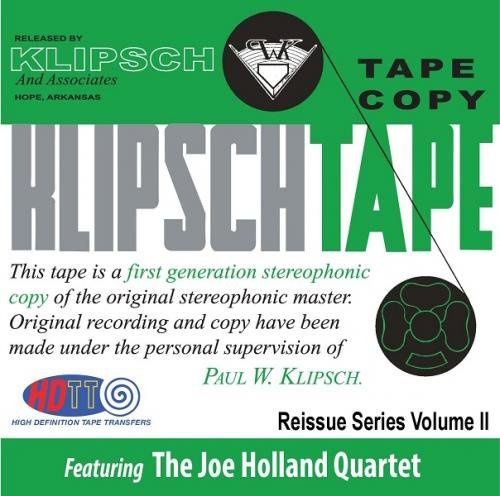
Joe Holland Quartet
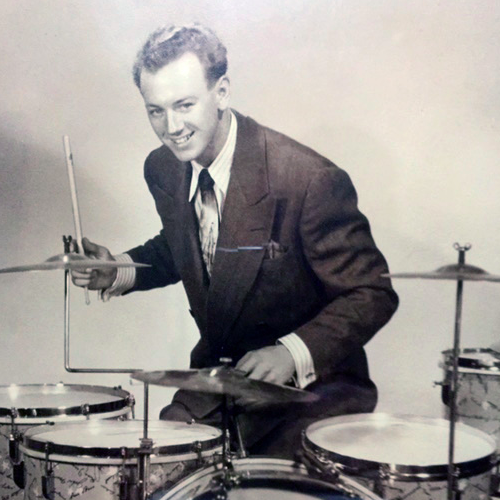
Legendary drummer Joseph “Joe” Holland has a unique and colorful origin and story, to the say the least. His career has been a string of interesting stories, celebrity encounters and time spent with Paul W. Klipsch.
These celebrities included Rosemary Clooney, Earl “Fatha” Hines and Candy Candido. The latter was a comic personality who had done many voice-overs, including work in the movie “The Wizard of Oz.” After this months-long tour concluded, the union recommended Joe to an all-girl band that had lost its drummer.
Joe got to sit in with the likes of Count Basie, Earl Hines and many other greats of the day. However, he would not be able to work with black musicians again until his army days. That would come in 1957, the night after the 101st Airborne’s occupation of Central High School in Little Rock. It was the night he met the great Art Porter Sr. at a club in downtown Little Rock.
Joe was an early Hi-Fi buff and had naturally heard of Paul Wilbur Klipsch. Joe built his own speakers but is quick to say that they were nothing compared to what PWK was doing. In early 1955, he drove from Shreveport to Hope on the off chance that he might meet Paul. He was amazed that PWK invited him in, and later took him to lunch.
Paul was “easy to meet, easy to talk to, and easy to get along with, just a great guy. I could sense that he was going to be a fun guy because I never knew what he was going to do or say.”
When Paul discovered that Joe had his drums in the car, he asked Joe to play them in a live versus recorded scenario during their first encounter. PWK said he wanted to play some records and asked Joe to bring his drums inside. He pointed a speaker right at Joe. He wanted Joe to play along with his Glen Miller music. Fortunately, Joe had just gotten out of the Army Band and knew all of the arrangements by heart!
Joe played along with the recorded drummer exactly, which fascinated PWK. This exercise was conducted in the hallway of what is now Klipsch’s Hope office building, with Joe not being able to see whether the source materials were records or tapes (dammit). The result was the beginning of a serious dialog on possible collaborations.
Shortly after, they were doing a live versus recorded demo for a large audience in an auditorium at Centenary College. Dealers and the public were invited. Curtains hid a speaker on one side and a drum set on the other. Joe would play and then a recording of Joe would be alternated. The audience was asked to identify the live performance. Several more of these demonstrations were staged.
Soon Paul suggested a recording session. On the morning of June 19, 1955, Joe and the short-lived Joe Holland Quartet entered KWKH in Shreveport, Louisiana. At the same time, Elvis Presley was exiting the studio. He and his band recorded all night due to Elvis’ proclivity to put five notes in a four-note bar. The band members were afraid to call him out, so they just kept telling him that they had made a mistake and needed another take. [Do not irritate Elvis!] Elvis’ drummer, D.J. Fontana was a good friend of Joe’s and related the events of the previous night.
The recording session lasted most of the day, but included no pictures or other documentation – just the music. All songs were recorded straight through without mixing. Playback at the studio was via a pair of Klipsch Rebels as they were small enough to fit in the back of Paul’s airplane. If there were a serious mistake or flaw noted in the initial playback, the whole number would be repeated. Only a few required retakes. Extraneous noises were left in some of the recordings. One noise that was thought to be the drummer’s chair squeaking was actually a pedal. Joe used a Ludwig Speed King, which has also been referred to as a “Squeak King.” Unfortunately, it is not known if any of the band members ever heard their finished product on Klipschorns. [Joe has not, but I plan to remedy that!] Joe had Rebels………………
In 1957, a second recording session was arranged with a reunited Joe Holland Quartet. Paul explained to Joe that during his demos at frequent dealer visits, many people would request a copy of the material. At the time, the KlipschTape division had just been created with the help of John Eargle. Joe recalls that John represented himself as an A&R man from RCA. As with the earlier recording session in 1955, PWK utilized a Berlant tape recorder and two widely spaced, omnidirectional Stephens microphones. The second session did not seem to impress the band like the first. A “been there, done that” mentality could have been at play.
PWK and Joe remained in contact for many years. Joe knew some generals at Barksdale Air Force base. He arranged to take a General Westmoreland (the “lesser” Westmoreland) up to Hope to visit with PWK. The General was a huge Klipsch fan, so it was somewhat amusing to see his “subservient posture” in Paul’s presence. Joe gave at least another general the same “audience with King Klipsch.” Much later, PWK orchestrated, pun intended, an invitation from Arthur Fiedler for Joe to play with the Boston Pops. Unfortunately, this never materialized due at least in part to the pressure of Joe’s day job.
In the 1980’s PWK ran into Joe at Cajun’s Wharf in Little Rock. It had been 20 years since they had seen each other but Paul instantly recognized Joe. At 88, Joe lives on the west side of Little Rock, and is still getting paid to play his drums.
photo: from website klipsch.com
Showing the single result