
![Beethoven, Ligeti & Lefkowitz [One Microphone Recording] [Pure DSD]](https://media.cdnb.nativedsd.com/storage/nativedsd.com/wp-content/uploads/2025/11/20154637/YAR40724620DSD-190x190.jpg "YAR40724620DSD.jpg")
Title: Beethoven, Ligeti & Lefkowitz
Beethoven: String Quartet No. 16 in F Major, Op. 135
Ligeti: String Quartet No. 2
Lefkowitz: Green Mountains, Now Black
Performer: Quartet Integra
Label: Yalung Records
For my first review on Native DSD, I have chosen this recording of string quartets. The reason is severalfold; this is a pure DSD recording, a format I firmly believe to be superior to all others, analogue tape included. Beethoven string quartets occupy a special place in my heart, and I am curious to hear an unfamiliar ensemble play this masterpiece, the last published work of the composer, hoping to hear a fresh approach to this much recorded work.
The Op.135 quartet is perhaps less ground breaking than some of his other late quartets that paved the way for the likes of Bartok, Messiaen and Shostakovich, since it took him back to his classical roots. Maybe it was Beethoven’s (sarcastic ?) response to the music critics of the time who failed to appreciate the originality of the earlier and more daring examples. My reference for these works are the 1966 recordings of the Amadeus Quartet on Deutsche Grammophon, of which I have the 4-track reel to reel tapes. The tapes came in three box sets labeled early, middle and late quartets respectively. Interestingly, Op.135 appeared in the early box set, joining the six Op.8 quartets where it stylistically belongs. Beethoven has come full circle in the end.
I listened to the recording (in DSD128) without knowing anything about the Quartet Integra. My immediate impression was that the playing was incisive and direct, with good rapport between the different members. It lacked a bit of the subtlety that one might expect from seasoned ensembles, but the overall presentation is very musical and satisfying. I have always had a soft spot for Beethoven’s slow movements, and the slow movement of this piece must be one of his most endearing. This was played here with great sensitivity without being langurous, with well-executed phrasing and dynamic shading.
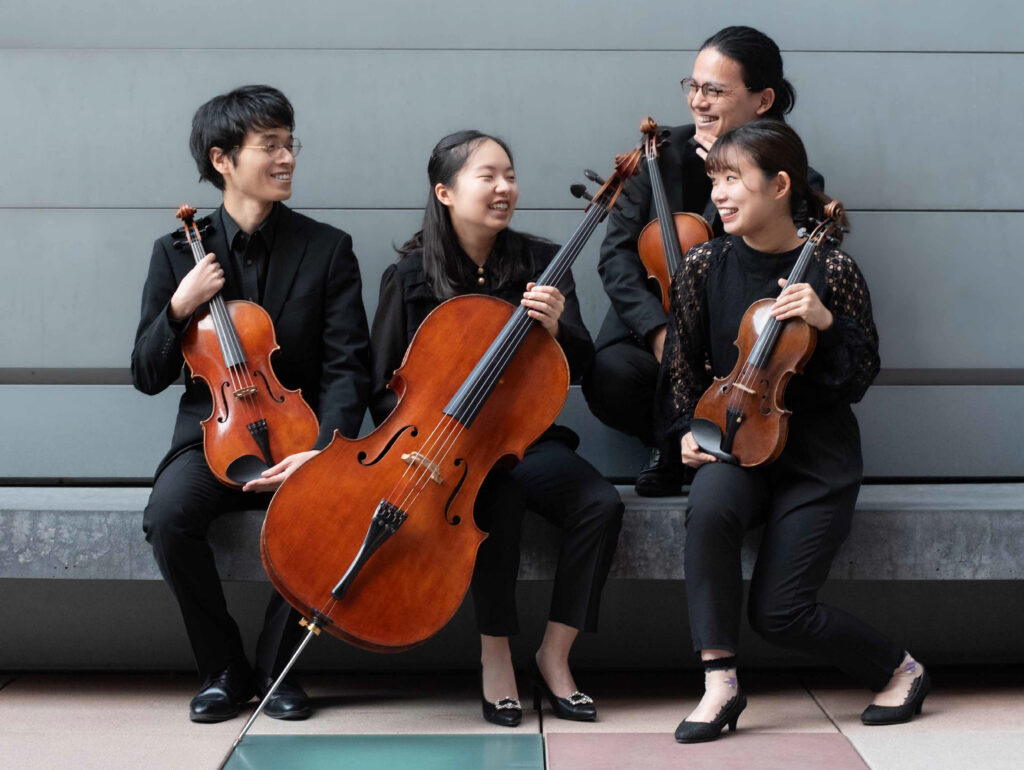
I read the accompanying booklet (actually a PDF file) afterwards and noted that the Quartet Integra is comprised of young players from Japan and Korea who were receiving instructions at the Colburn School in Los Angeles at the time (April 2025). This puts their achievement in perspective, as the performance suggests a maturity beyond their years. Late Beethoven presents formidable challenges musically if not technically to young players who lack the life experience to understand the music of someone as tormented. As an amateur pianist, I found the challenge overwhelming during my formative years, and only began to seriously tackle the late sonatas after I have turned 50. But even after ten years, I often still find myself confounded.
The Ligeti quartet presents a totally different set of challenges. Technically, it is quite unlike anything else that has existed before. My initial impression is that it sounds electronic, which is ironic since electronic instruments were invented to circumvent the limitations of traditional instruments in producing new sounds. Ligeti proved that there is still room for “traditional” musical forms to evolve. I would describe the first two movements as highly expansive soundscapes, and I concur with the writer of the booklet that the composer was perhaps referencing the cosmos, as the sound can only be described as cosmic. The third movement, played pizzicato in its entirety, is marked “Come un meccanismo di precisione”, and it indeed reminds me of the sound of clockwork. The last two movements sound impossibly virtuostic, and evoke a sense of urgency and disquiet. One is initially impressed by the technical accomplishments of the players, but on repeat hearing, one can sense the chaos and entropy inherent in our universe.
The third piece by David S. Lefkowitz was written last year and was inspired by the scene of the devastating fire in Los Angeles. Despite its modernity, it is a lyrical piece, at once conveying the sadness of the destruction as well as the hope for healing and renewal. The playing is beautiful and heartfelt, and its meaning goes beyond the original tragedy in a world that is facing profound changes and uncertainties.
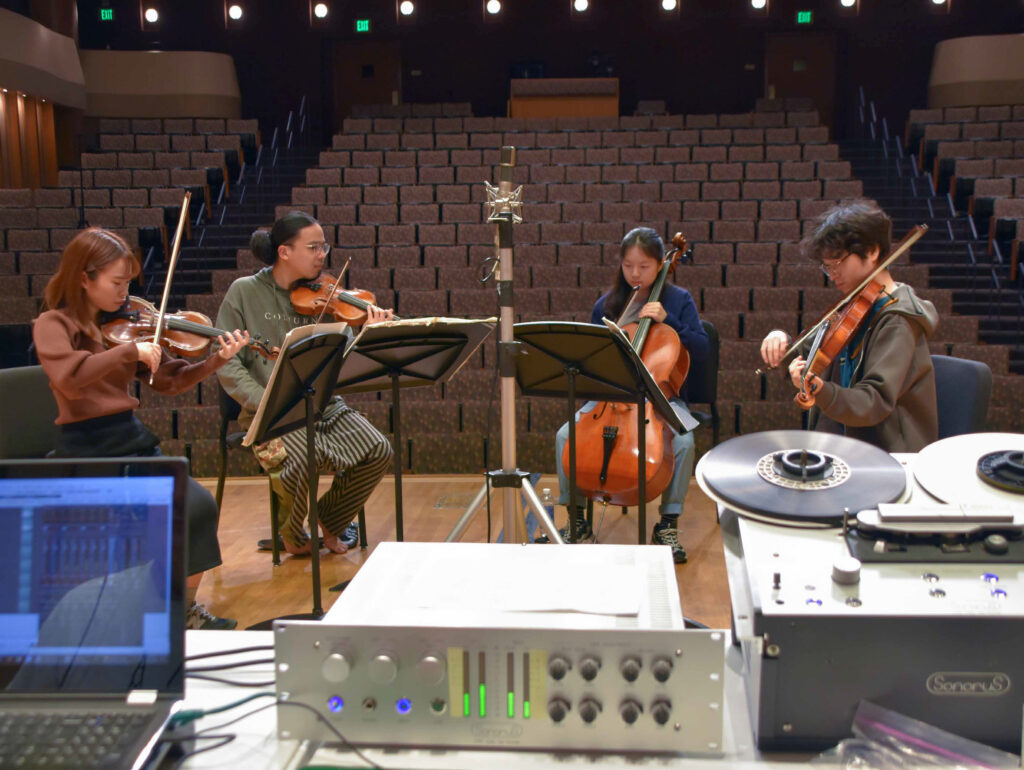
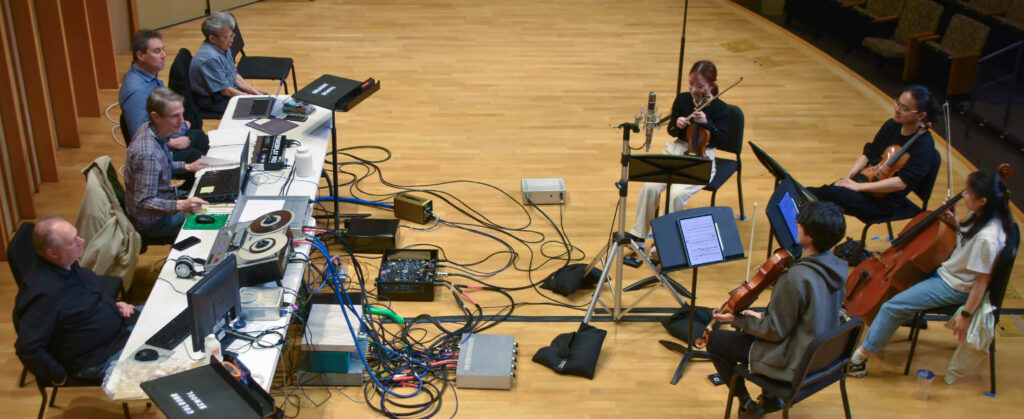
On the technical side, this recording was made with a single AKG C24 stereo microphone. This microphone is equivalent to two of the legendary C12 microphones arranged one on top of the other, with selectable response patterns for mid-side and XY stereo pairs. I have recorded with a similar set up using the Neumann SM2. It is a purist approach that demands precise microphone placement to achieve an optimum balance between the instruments. The booklet also mentions that SonoruS Holographic Imaging technology was used to “refine” the stereo image. The explanation of the technology offered by the SonoruS website simply states that the technology recreates the three dimension soundfield captured by the microphones for a typical stereo setup of a home audio system. On my system, the image is widely spread between the limits of the speakers, placed quite forward with limited depth. There are good spatial cues, but there is little blending of the individual instruments, unlike what one experiences when listening to a quartet in a concert hall or salon. By contrast, the Amadeus Quartet recordings do not sound as wide, but the instruments are more realistically proportioned and sound more like an ensemble than individual soloists. The tone of the instruments on this recording is realistic, but there is a hint of hardness during fortissimo. This is however different from the brightness and glassiness of many PCM recordings, and is only apparent to someone used to the sound of analogue formats, which perhaps soften the hard edges of string instruments.
Overall, this is a very worthwhile recording of an old war horse and two less familiar works. The playing is polished and refined, highly impressive for the four artists at the beginning of their careers. The sound is of course system-dependent, and maybe a tad forward on my system, which utilizes highly sensitive horn compression drivers with metal diaphragms. On the other hand, it is tonally accurate with life-like dynamics.