Welcome to ‘Dodd’s Discoveries’, a review series from NativeDSD Senior Music Reviewer Bill Dodd. This series focuses on Bill’s latest selections, with new reviews regularly. And the best part… the albums featured in the most current review will be available at a reduced price! Click the button below to see all of Dodd’s Discoveries and to find the current album(s) on sale.
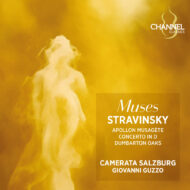
Stravinsky’s “Big Three”, The Rite of Spring, Firebird, and Petrushka, are literally cultural icons. Hundreds of recordings, new and re-releases, have had a huge presence in concerts and in record sales. They each have a bold narrative, and are written for big orchestras. But the three neoclassical works on this album, Apolon Musagete, Dumbarton Oaks, and Concerto in D, are just as loved by musicians–- and in many cases more so.
Neoclassical is a term that often scares people away. They may think of it meaning angular, cold, mechanical music. I was in my 20s before I discovered the richness of Stravinsky’s 1920-1950 works, and while they are structured, and have a definite rhythm, they are not “cold”.
The epic CBS Records massive cycle of Stravinsky conducting his own works was what introduced many of his later works to not only the public, but to musicians. These recordings also codified how these works were intended to be played.
This album features the Camerata Salzberg, conducted by Giovanni Guzzo, which turns out to be a superb group of musicians who absolutely show what these three works can be. Add to that, Jared Sacks has outdone himself in capturing sound so real that you will start looking for the players.
My favorite, with its serene beauty, is Apolon Musagete, but Dumbarton Oaks and the Concerto in D are equally superb. These performances set the standard for modern recordings of three of Stravinsky’s best later works.
You may also be interested in: