

The MANS Method (Measurement Audio Natural Sound) is a new way to test sound reproduction quality. Conceived and developed by Maestro Igor Fiorini — musician, Sound Director, and producer. It uses specially recorded and processed audio tracks to evaluate, in a conscious and rigorous way, the quality of any sound reproduction system.
Each track of the MANS Test Disc is accompanied by an audio guide explaining the specific purpose of the track and what to listen for when evaluating the system’s ability to reproduce all sonic information correctly: spatial reconstruction, harmonic structure, and dynamic behavior. The evaluation is based on a guided and attentive listening process. The result is a structured and methodical listening experience, grounded in the perception of reproduced sound, where the measuring instrument is the human listener and their sensory perception.
This project was originally developed in collaboration with the Japanese car manufacturer Mazda, to test its Harmonic Acoustic in-car sound systems, designed by audiophile engineer Koji Wakamatsu, and developed according to the human-centric design philosophy that characterizes Mazda’s engineering approach in Hiroshima. The MANS method is rooted in the same philosophy: placing the human being — in this case, the listener — at the center of the experience, making them an active and conscious measuring instrument. Through attentive, holistic, yet rigorous listening, the MANS method becomes a scientifically reliable tool, thanks to recordings and processing techniques specifically designed to make auditory perception evaluation repeatable and unambiguous.
While the disc was originally created to test Mazda Harmonic Acoustic systems and to better understand how sound quality influences driving comfort and enjoyment, it also serves as an ideal tool for evaluating any home or professional audio playback system. Each test track is preceded by an audio guide explaining the listening parameters and sonic characteristics to be examined.
Sound and Music: constitutive parameters
Sound is the primordial element of music.
The MANS method identifies five fundamental parameters to describe it:
- Transient
- Envelope
- Decay
- Homogeneity
- Sound spectrum
(The SlowSound – Accademia del Suono logo, inspired by ideograms, visually represents these five elements on the cover, with a conceptual horizontal separation and connection between Homogeneity and Envelope.)
Music, on the other hand, is characterized by its own constitutive elements: pitch, rhythm, dynamics, and timbre.
Together, sound and music determine the pleasure and emotional engagement of listening. When these elements are placed in space, they give rise to a macro-parameter that is often responsible for the most immersive emotional involvement: spatiality — the distribution of sounds in space, forming a virtual soundstage. In the MANS method, spatiality is analyzed and modeled through a zonal system.
These ten parameters, taken together, generate a holistic perception that defines the pleasure of listening to music. For Mazda, they also represent an essential component of the onboard travel experience. Mazda’s Harmonic Acoustic system — developed by engineers in parallel with the chassis and interior design — enables accurate and coherent reconstruction of all ten parameters described above, integrating them seamlessly with the sounds generated during vehicle motion, to deliver one of the most complete and refined driving sound experiences currently available in an automobile.
The MANS Method in practice
The MANS method uses live-recorded piano tracks, carefully processed and mastered to emphasize maximum detail, transient accuracy, density, envelope, decay, and multiple harmonic components. These tracks allow for rapid identification of a playback system’s ability to reproduce each of these characteristics. For example, within each note, both lower and upper harmonics are present and can be clearly identified during listening.
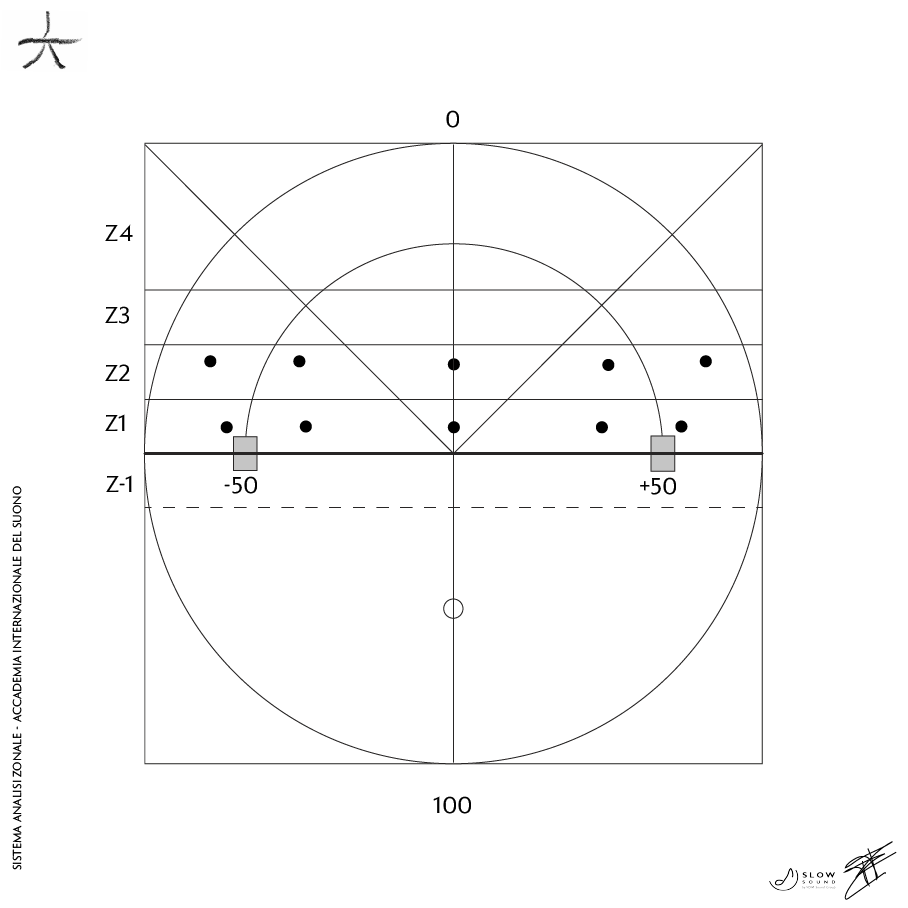
The advantage of these test tracks — often based on a single musical note — is that they allow the sonic elements to be schematized, enabling analytical comparisons by auditory memory, even over time and across different systems. To evaluate the macro-parameter of spatiality, Maestro Fiorini created eight tracks derived from the same musical passage, transforming the recording into a point-source sound object placed in five closely spaced positions from left to right. Each track makes it possible to precisely identify sound reproduction along the horizontal axis as well as depth perception.
The accompanying diagram clearly illustrates where each track should be perceived in space.
VDM Records Artists (Tracks 1-15)
Monaldo Braconi, Pianist (Track 16)
Ferentino Wind Orchestra (Track 16)
Alessandro Celardi, Conductor (Track 16)
Duo Improbabile (Track 17)
Marco Arcieri, Pianist (Track 18)
Tracklist
Please note that the below previews are loaded as 44.1 kHz / 16 bit.Total time: 01:08:08
Additional information
| Label | |
|---|---|
| SKU | VDM03855049 |
| Qualities | DSD 512 fs, DSD 256 fs, DSD 128 fs, DSD 64 fs, DXD 32 Bit, DXD 24 Bit, FLAC 192 kHz, FLAC 96 kHz |
| Channels | |
| Artists | Alessandro Celardi, Duo Improbabile, Ferentino Wind Orchestra, Marco Arcieri, Monaldo Braconi, VDM Records Artists |
| Composers | |
| Genres | |
| Original Recording Format | |
| Release Date | February 6, 2026 |
Only logged in customers who have purchased this product may leave a review.





Reviews
There are no reviews yet.