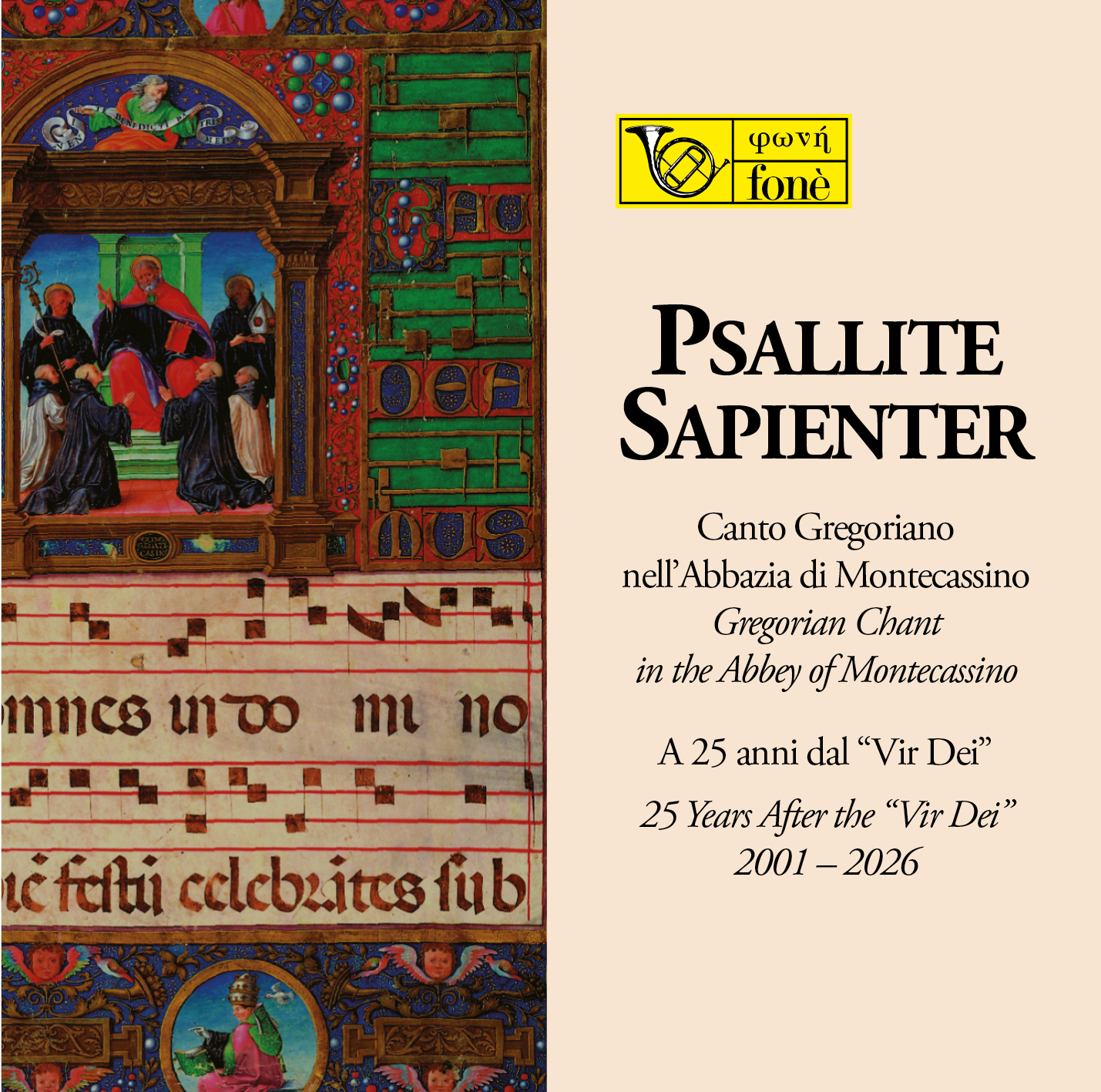
“Sing Psalms with understanding”: this invitation from Psalm 46 (47) has been and continues to be one of the deepest desires of a monk — who, by following Saint Benedict’s counsel to prefer nothing to the Opus Dei, that is, to prayer, longs to live it with wisdom and beauty, in truth and depth. The Psalm constitutes the predominant part of the Liturgy of the Hours in a monastery and throughout the whole Church. Their verses often resound in the antiphons of the Missal; they are the Word of God most frequently listened to, meditated upon, and prayed each day.
A great Jewish intellectual of the last century, André Chouraqui — a scholar and translator of the Scriptures (he even translated the New Testament) — wrote of the Psalter: “We are born with this book in our very entrails. A little book, one hundred and fifty poems, one hundred and fifty steps erected between death and life; one hundred and fifty mirrors of our rebellions and our fidelities, our agonies and our resurrections. More than a book, a living being that speaks — that speaks to you — that suffers, groans, and dies, that rises and sings on the threshold of eternity — and it takes you, and carries you and the ages of ages, from beginning to end…” Many centuries earlier, another of the greatest commentators on the Psalter, Augustine of Hippo, could exclaim: psalterium meum gaudium meum — the Psalter is my joy!
“We are born with this book in our entrails,” a book that is “my joy”: such an experience — existential even before being spiritual or religious — could not help but be expressed in musical notes and in song. This has been true since ancient times, and still today, in our Bibles, at the beginning of many psalms there are brief notes indicating the melodies or instruments by which the psalm was to be accompanied or sung. In the Western Christian liturgy, it was above all the Gregorian tradition that gave musical form to the prayer of the psalms and to other liturgical texts, doing so with great wisdom — obedient to the imperative of Psalm 46, psallite sapienter — not imposing itself upon or over shadowing the words of the Psalter, but rather highlighting and amplifying the richness already contained within them. In his Rule, Saint Benedict offers a precious indication on how the psalms should be prayed: “Let us so sing the psalms that our mind may be in harmony with our voice” (RB 19:7). It is not merely a question of paying attention to what is said, but more profoundly of finding a harmonious accord between the heart and what the lips pronounce.
Monastic Choir of the Abbey Montecassino
Stefano Concordia, director
Tracklist
Please note that the below previews are loaded as 44.1 kHz / 16 bit.Total time: 00:54:14
Additional information
| Label | |
|---|---|
| SKU | SACD276 |
| Qualities | |
| Channels | |
| Artists | |
| Genres | |
| Original Recording Format | |
| Instruments | |
| Analog to Digital Converter | dCS904 |
| Recording Engineer | Giulio Cesare Ricci |
| Recording Location | Montecassino Abbey, Italy |
| Equipment | Microphones: n.2 Neumann U47 old tube microphones n.2 Neumann M49 old tube microphones Other Gear: analog Tape Recorder Nagra 4s 38cm/sec 1/4 inch advanced mike pre-amplifiers Nagra |
| Release Date | April 10, 2026 |
Only logged in customers who have purchased this product may leave a review.
Reviews
There are no reviews yet.