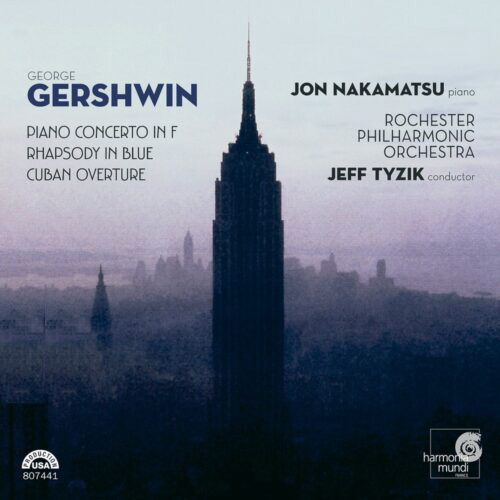
Penned for the concert hall but brimming with the sounds and rhythms of Tin Pan Alley and Broadway, this all-Gershwin program from Harmonia Mundi features American pianist Jon Nakamatsu in the Piano Concerto in F and the Rhapsody in Blue. For an orchestral encore, Jeff Tyzik leads the Rochester Philharmonic Orchestra in an exuberant reading of the Cuban Overture.
Gershwin’s music really is hard to label. With a creative range that won him successes both on Broadway and in Carnegie Hall, it could scarcely be otherwise for this pioneer “crossover” artist. But why try to pigeonhole such brilliance? Better simply to enjoy it’
He gradually broke into the pop song market he had come to know so well from the inside. The first of his songs to see print appeared in 1916. It bore the memorable title When You Want ’Em, You Can’t Get ’Em, When You’ve Got ’Em, You Don’t Want ’Em. He had to start somewhere! By the early ’20s, he was earning a healthy income from his own material. For several years he had also been taking private instruction in classical techniques. Sooner or later these two streams were bound to merge.
The premiere of Rhapsody in Blue took place as planned on February 12, 1924, in New York’s Aeolian Hall. Gershwin himself played the solo part. It came at the end of a long, varied program, but it was still received with overwhelming enthusiasm. This irresistible blend of ’20s jazz and daredevil classical virtuosity remains one of the most beloved and frequently performed of all American compositions.
Walter Damrosch, conductor of the New York Symphony Orchestra, was in the audience when Gershwin’s rhapsody made its debut. Impressed by its unprecedented amalgamation of popular and classical styles, he commissioned Gershwin to compose a full-scale piano concerto. “Many persons had thought that my rhapsody was only a happy accident,” Gershwin wrote. “Well I went out, for one thing, to show them that there was plenty more where that came from. I made up my mind to do a piece of ‘absolute’ music.”
Jon Nakamatsu, Piano
Rochester Philharmonic Orchestra
Jeff Tyzik, Conductor
Tracklist
Please note that the below previews are loaded as MP3.Total time: 01:01:12
Additional information
| Label | |
|---|---|
| SKU | HMU907441 |
| Qualities | |
| Channels | 2ch Stereo, 5 Channel Surround Sound, 2ch Stereo & 5ch Surround |
| Artists | |
| Composers | |
| Genres | |
| Recording Software | Pyramix |
| Recording Type & Bit Rate | DSD64 |
| Recording location | Rochester New York |
| Recording Engineer | Brad Michel / Chris Barrett DSD engineer |
| Producer | Brad Michel |
| Digital Converters | Meitner DSD AD/DA |
| Original Recording Format | |
| Conductors | |
| Instruments | |
| Release Date | April 30, 2014 |
Press reviews
Classics Today
Pianist Jon Nakamatsu and Conductor Jeff Tyzik team up for what unquestionably is the best Gershwin album to come along in years.
In Tyzik’s case, he clearly understands how to inflect a melody while maintaining a strong, steady rhythm. You can hear this very clearly in Rhapsody in Blue (the uncut, full-orchestra version), where both soloist and conductor understand the need to get back to the main tempo after each digression or sectional ritard. In the long, quasi-accompanied cadenza just before the “big tune”, Nakamatsu knows exactly when to muse, when to push purposefully forward, and how to interact with his fellow players (check out the passage for piano and solo horn). It’s a splendid performance that really holds this episodic piece together while still conveying a full measure of the music’s spontaneity and flow.
If anything, the Piano Concerto is even better. The swift opening tempo gives the persistent Charleston rhythms an irresistible lilt. Nakamatsu’s quicksilver opening run promises a reading that captures the music’s elegance and wit as few pianists have since Earl Wild. His rubato always sounds natural, and there isn’t a trace of heaviness in the central development section, nor a single bar that sounds mechanical. The central nocturne has great poetry that never bogs down in foggy reverie, and the finale is a barn-burner–driving, exciting, with Nakamatsu technically outstanding in the repeated-note main theme.
Tyzik has a chance to strut his stuff in the Cuban Overture, the best performance of that chestnut to come along in many a moon as well. The Latin percussion is perfectly balanced against the larger orchestra, and the entire build-up from the slow middle section to the return of the opening music offers an object lesson in how this music should be conducted. The Rochester Orchestra plays very well throughout, with fine solos from the principal trumpet (in the concerto) and clarinet (in the Rhapsody).
Harmonia Mundi’s engineering complements the performances in all formats. There’s plenty of front-to-back depth of perspective, especially in 5 Channel DSD Surround Sound. But also excellent clarity and very natural balances both among the various orchestral sections and between piano and ensemble. You’ll love this album!
Only logged in customers who have purchased this product may leave a review.

Reviews
There are no reviews yet.